Products Resources Service & Support News & Events
About Us / Contact Us
PRODUCTS > HUMAC NORM > PRODUCT OVERVIEW > PATTERNS
Return to HUMAC NORM Overview

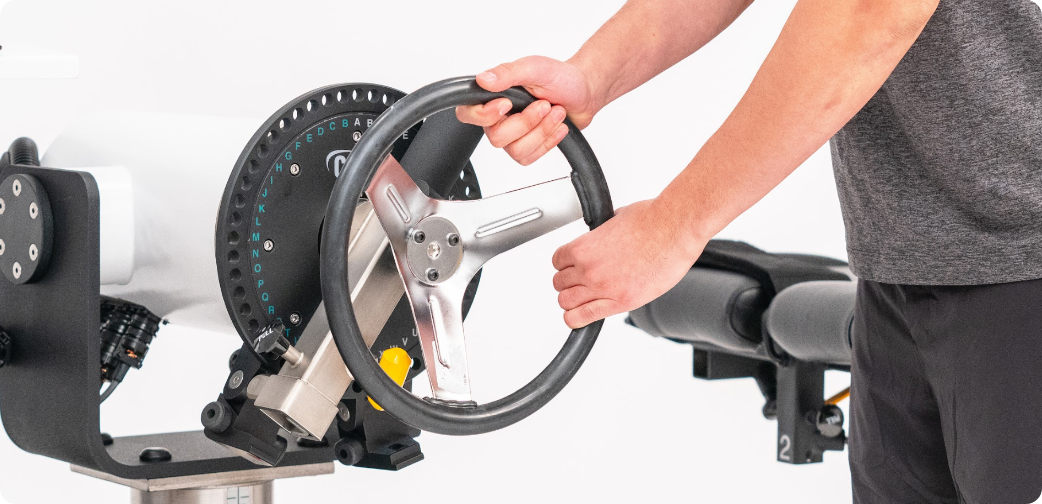
The HUMAC NORM includes attachments to perform 22 isolated patterns covering the shoulder, elbow, wrist, hip, knee, and ankle. Isolated patterns are used to accurately and carefully measure and build the foundation for safe functional testing and exercise.

Optional attachments add Work Simulation and Trunk extension / flexion patterns.

Patterns
Placeholder
To jump to a specific set of patterns, choose from the list below:
Knee Ankle
Elbow PNF D1
Forearm / Wrist PNF D2
Hip Trunk (Optional)
Shoulder  


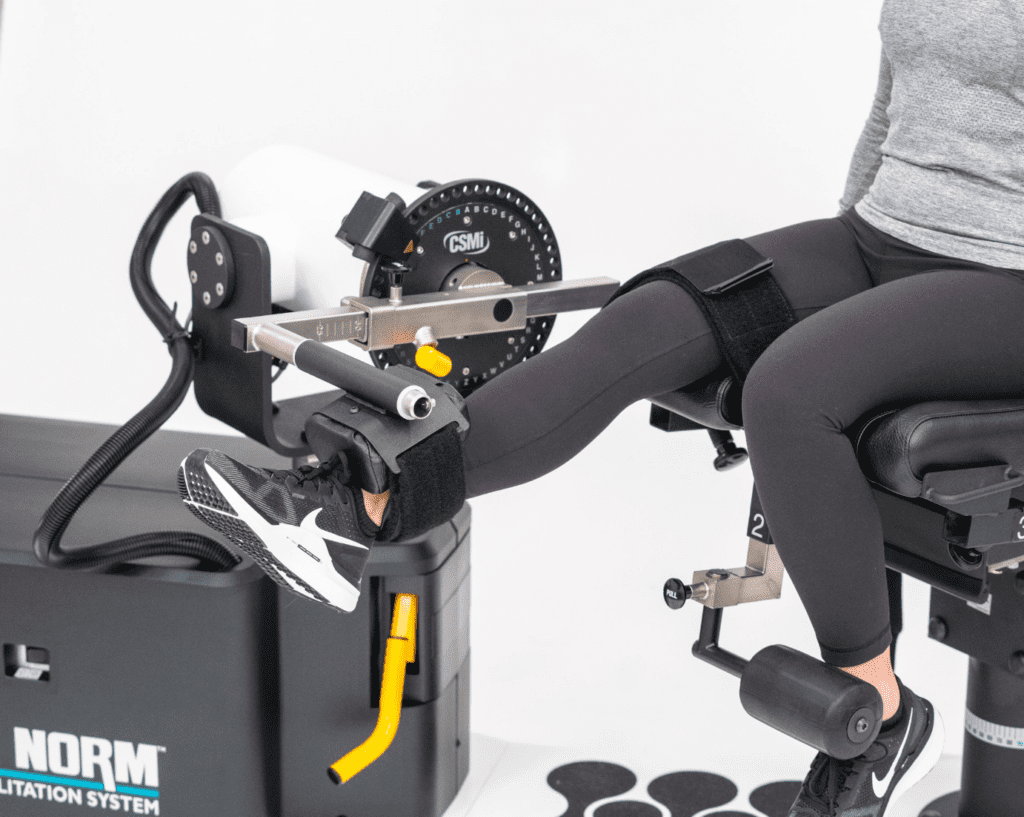
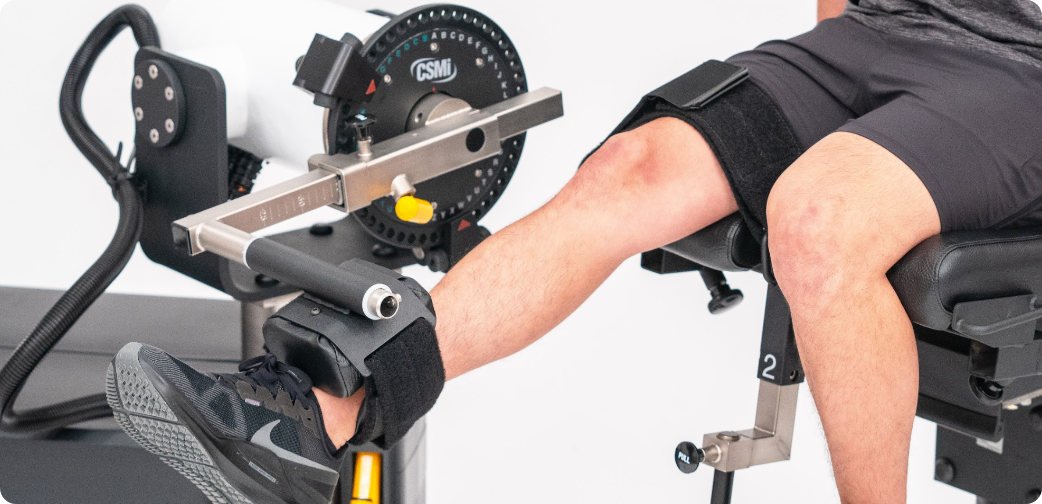
Knee: Extension / Flexion Seated
Axis of Rotation:
The most accurate fixed axis for rehab or testing of the knee is a line passing transversely through the femoral condyles.
Parts Needed:
Contralateral Limb Stabilizer
Knee/Hip Adapter
Knee/Hip Pad
Lumbar Cushion
Back to Top

Knee: Extension / Flexion Prone
Axis of Rotation:
The most accurate fixed axis for rehab or testing of the knee is a line passing transversely through the femoral condyles.

Parts Needed:
Knee/Hip Adapter
Knee/Hip Pad
Back to Top

Knee: Tibial Internal / External Rotation
Axis of Rotation:
The axis of rotation is slightly medial to the longitudinal axis of the tibia. This can be visualized, approximated and then fine adjusted during warm up/familiarization repetitions.
Parts Needed:
Ankle Adapter
Footplate
Thigh Stabilizer Pad
Thigh/Forearm Stabilizer Tube
Footrest
Back to Top


Ankle: Plantar / Dorsiflexion Prone
Axis of Rotation:
The axis of rotation passes obliquely (approximately 16° anteromedially) through the tip of the fibula (lateral malleous) and the trochlea of the talus, exiting just distal to the tip of the tibia (medial malleous).
Parts Needed:
Ankle Adapter
Footplate
Back to Top

Ankle: Plantar / Dorsiflexion Supine
Axis of Rotation:
The axis of rotation passes obliquely (approximately 16° anteromedially) through the tip of the fibula (lateral malleous) and the trochlea of the talus, exiting just distal to the tip of the tibia (medial malleous).
Parts Needed:
Ankle Adapter
Footplate
Footrest
Thigh Stabilizer Pad
Thigh/Forearm Stabilizer
Counterbalance Weight
Back to Top

Ankle: Inversion / Eversion
Axis of Rotation:
The axis is compound and changes throughout range of motion of the talo-crural joint, talocalcaneal joint and talonavicular/ calcanecuboid or transverse tarsal joint.
Parts Needed:
Ankle Adapter
Footplate
Thigh Stabilizer Pad
Thigh/Forearm Stabilizer Tube
Footrest
Back to Top


Shoulder: Abduction / Adduction
Axis of Rotation:
The instantaneous axis of rotation changes throughout the movement. The compromise axis is medial to the acromion process when the limb is in the neutral position.
Parts Needed:
Elbow/Shoulder Adapter
Footrest
Lumbar Cushion
Back to Top

Shoulder: Extension / Flexion
Axis of Rotation:
The instantaneous axis of rotation changes throughout the movement. The compromise axis is medial to the acromion process when the limb is in the neutral position.
Parts Needed:
Elbow/Shoulder Adapter
Footrest
Back to Top

Shoulder: Horizontal Abduction / Adduction
Axis of Rotation:
The instantaneous axis of rotation changes throughout the movement. The compromise axis is medial to the acromion process when the limb is in 90° horizontal abduction.
Parts Needed:
Elbow/Shoulder Adapter
Footrest
Torso Belt
Back to Top

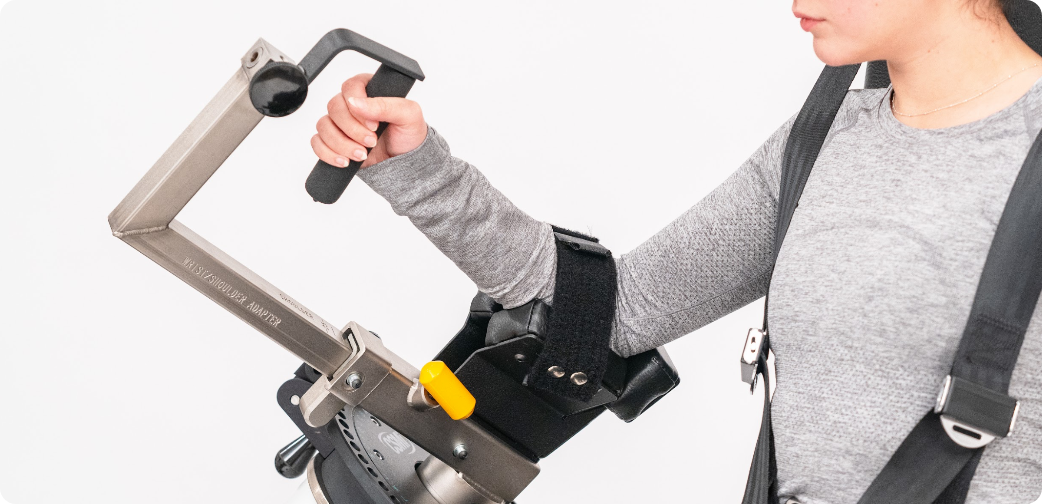
Shoulder: Internal / External Rotation in 90º Abduction
Axis of Rotation:
The axis of rotation is the longitudinal axis of the humerus.
Parts Needed:
Wrist/Shoulder Adapter
Elbow Stabilizer Pad
Torso Belt
Footrest
Back to Top

Shoulder: Internal / External Rotation, Mod Standing
Axis of Rotation:
The axis of rotation is the longitudinal axis of the humerus.
Parts Needed:
Wrist/Shoulder Adapter
Elbow Stabilizer Pad
Back to Top

Shoulder: Internal / External Rotation, Mod Seated
Axis of Rotation:
The axis of rotation is the longitudinal axis of the humerus.
Parts Needed:
Wrist/Shoulder Adapter
Elbow Stabilizer Pad
Lumbar Cushion
Back to Top

Shoulder: Internal / External Rotation in 90º Flexion
Axis of Rotation:
The axis of rotation is the longitudinal axis of the humerus. If length adjustment of wrist / shoulder adapter is correct, and elbow flexed at 90° with forearm parallel to input arm, the axis alignment will be established and maintained by the Elbow Stabilization Pad.
Parts Needed:
Wrist/Shoulder Adapter
Elbow Stabilizer Pad
Back to Top


PNF D1: Flexion - Adduction / Extension - Abduction
Axis of Rotation:
The instantaneous axis of rotation changes throughout the movement. The compromise axis is medial to the acromion process when the limb is in the neutral position. The motion for this pattern begins in full Extension-Abduction and moves to full Flexion-Adduction, the limb should be supinated and externally rotated.
Parts Needed:
Elbow/Shoulder
Adapter Footrest
Back to Top


PNF D2: Flexion - Abduction / Extension - Adduction
Axis of Rotation:
The instantaneous axis of rotation changes throughout the movement. The compromise axis is medial to the acromion process when the limb is in the neutral position. The motion for the pattern begins in full Extension-Adduction and moves to full Flexion-Abduction. In order to attain full Extension-Adduction, the limb should be pronated and internally rotated.
Parts Needed:
Elbow/Shoulder Adapter
Footrest
Torso Belt
Back to Top


Forearm: Pronation / Supination
Axis of Rotation:
The axis of rotation bisects the head of the ulna distally and the head of the radius proximally. It is established by placing the forearm directly in line with the dot on the dynamometer input tube at approximately the level of the ring finger.
Parts Needed:
Thigh/Forearm Stabilizer Tube
Forearm Stabilizer V-Pad
Wrist/Shoulder Adapter
Lumbar Cushion
Counterbalance Weight
Back to Top

Wrist: Extension / Flexion
Axis of Rotation:
This axis alignment is critical and somewhat difficult in the pattern. The axis of rotation is slightly oblique passing through the wrist just distal to the tubercle of the radius and the head of the ulna (approximately where the hand meets the wrist).
Parts Needed:
Thigh/Forearm Stabilizer Tube
Forearm Stabilizer V-pad
Wrist/Shoulder Adapter
Lumbar Cushion
Back to Top

Wrist: Radial / Ulnar Deviation
Axis of Rotation:
The axis of rotation is located approximately at the center of the capitate bone. This is found at the middle of the wrist just distal to the axis for extension/flexion.
Parts Needed:
Thigh/Forearm Stabilizer Tube
Forearm Stabilizer V-pad
Wrist/Shoulder Adapter
Lumbar Cushion
Back to Top


Elbow: Extension / Flexion
Axis of Rotation:
The axis of rotation is immediately distal to the lateral epicondyle and moves only slightly anteriorly as flexion increases.
Parts Needed:
Elbow/Shoulder Adapter
Footrest
Lumbar Cushion
Back to Top


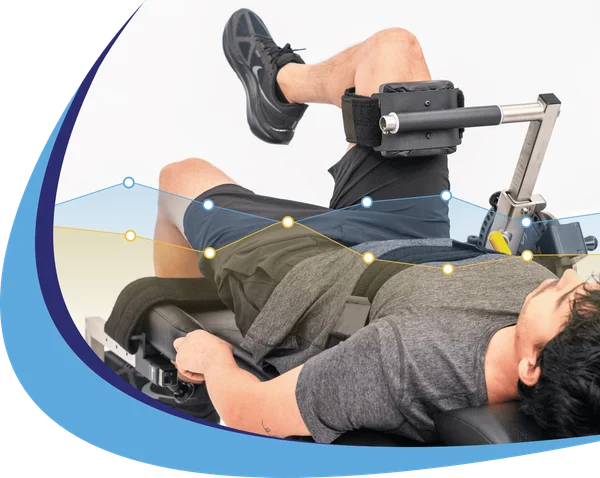
Hip: Abduction / Adduction
Axis of Rotation:
The axis of rotation is superior and medial to the greater trochanter.
Parts Needed:
Knee/Hip Adapter
Knee/Hip Pad
Back to Top

Hip: Flexion / Extension
Axis of Rotation:
The axis of rotation is slightly anterior in extreme flexion as the pelvis tilts to increase range of motion. The normal movement synergy does not affect testing accuracy.
Parts Needed:
Knee/Hip Adapter
Knee/Hip Pad
Footrest
Back to Top

Hip: Internal / External Rotation
Axis of Rotation:
The axis of rotation is a mechanical axis of the femur (line through centers of hip and knee joints). This can be visualized, approximated and then fine adjusted during warm up/familiarization repetitions.
Parts Needed:
Ankle Adapter
Footplate
Footrest
Back to Top


Trunk: Flexion / Extension
Axis of Rotation:
The axis of rotation is located at the L5-S1 level. To align the axis: Vertically - adjust the footplates until the axis alignment pointer on the unit is approximately 1” distal to the iliac crest. Horizontally - have the patient lean against the rear pad. Adjust fore/aft position until the axis alignment pointer intersects the mid-axillary line and L5-S1.
Parts Needed:
TEF Modular Component
Back to Top


Return to HUMAC NORM Overview
 
Home  |  Products  |  Resources  |  Service & Support  |  News & Events  |  About Us  |  Contact Us  |  Site Admin  |  Email Access